

Are you a teen or young adult who has just started working? Read on for six things to do before (and after) you get your first paycheck.
Before we begin, if you haven’t already, now is a great time to open a checking account.
(And just a note that AI was NOT involved in the writing of this post.)
Set up direct deposit
If there’s an option to set up direct deposit before your first paycheck, go for it! If not, set it up as soon as you’re able to. Direct deposit means that the money goes straight into your account; no stopping at work to pick up your check and no depositing your check via an app or at the bank.
If there’s an option to deposit the money into two different accounts, that’s also ideal — most in checking and a little (or more) in savings.
J’s employer did not offer percentage-based allocation, meaning he couldn’t put 10% of his paycheck into savings. So he chose a fixed amount — $20 from each paycheck (not knowing how many hours he would have).
You can always add more to savings later, but saving at least some from each paycheck is a great start.
Calculate your paycheck
Your paycheck isn’t just a random, unknown amount! You should be able to calculate about how much each paycheck will be. You’ll need:
- The pay period (start and end date)
- The approximate number of hours you worked during that time period
- Your hourly rate
For example:
- Pay period: 05/16/2026 – 05/29/2026
- Hours worked during that time: 22
- Rate: $16.50
- 22 x $16.50 = $363
The number that you calculate is your gross pay, meaning no taxes have been taken out. It’s difficult to know exactly how much will be taken out in taxes, but you can estimate anywhere from 15%-30%. Gross pay – deductions (taxes, etc.) = net pay (or take-home pay).
What type of taxes will be taken out? It depends, but here are a few examples of taxes you might see on your paycheck:
- Federal Tax
- State tax
- State local tax
- SUI (State unemployment insurance)
- Social Security
- Medicare
So in our example, $363 x 15% = $54.45 in taxes. $363 – $54.45 = $308.55 net.
Get your pay stub
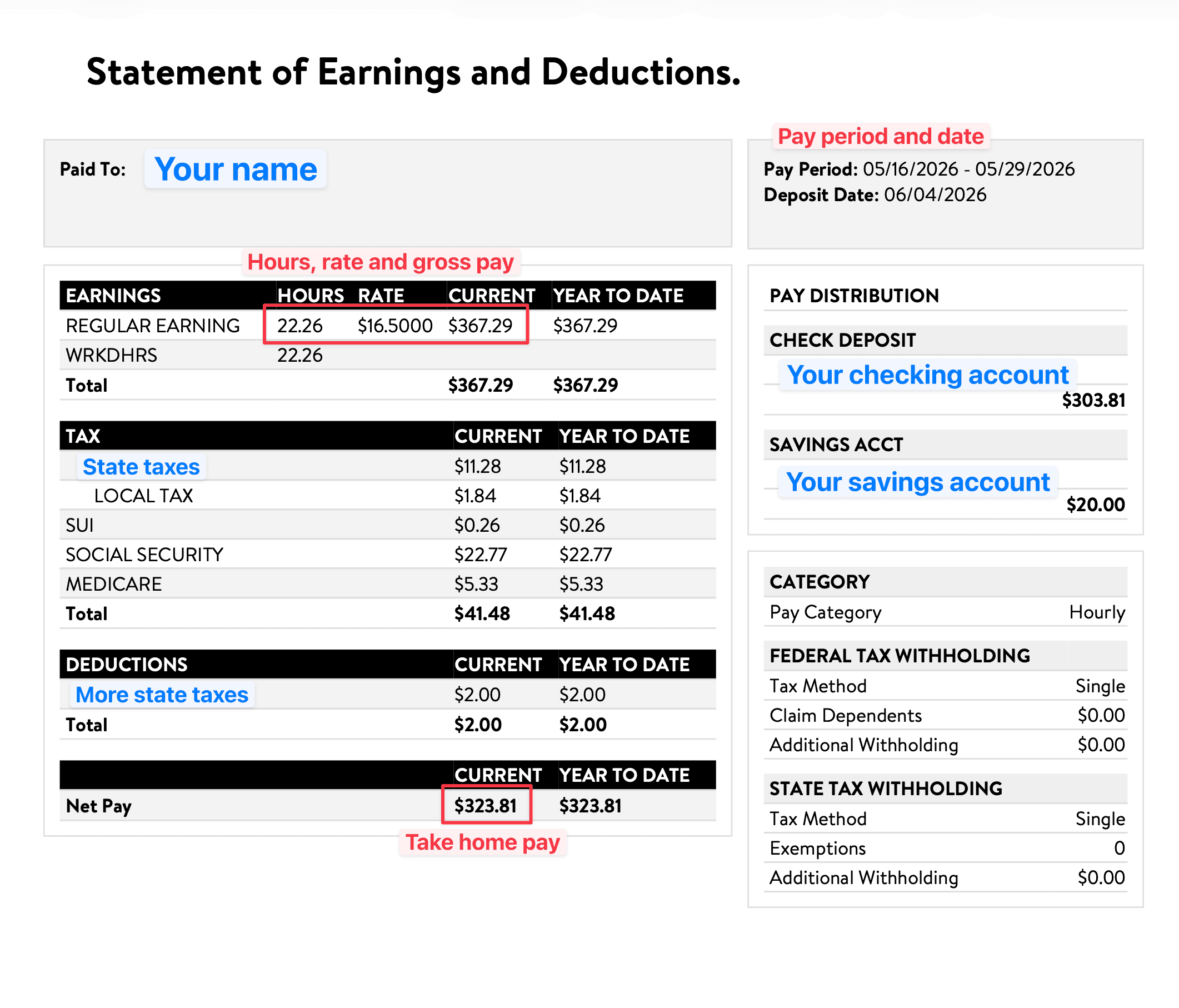
After you calculate how much you think you’ll be getting paid, check your pay stub! Your pay stub details everything — pay period, pay date, hours worked, hourly rate, exactly how much is taken out for each type of tax, and more.
Many employers now offer digital pay stubs, meaning that you can get these electronically or via an app or website.
It’s good to double check your employer’s numbers against yours.
Here’s an example of a pay stub with all of the important information highlighted.
I’m sentimental, so I also think it’s great to keep your first pay stub.
And speaking of your first pay stub, don’t forget about your last pay stub! When you quit your job (most people don’t continue working at their first job forever, right?), it may be a bit harder to get your last pay stub. Take note of your employee ID number and ask HR how to get your last pay stub once your employment has ended.
Set up buckets for saving and spending
Instead of looking at one (big) lump sum in your checking account, divide it up into buckets or categories.
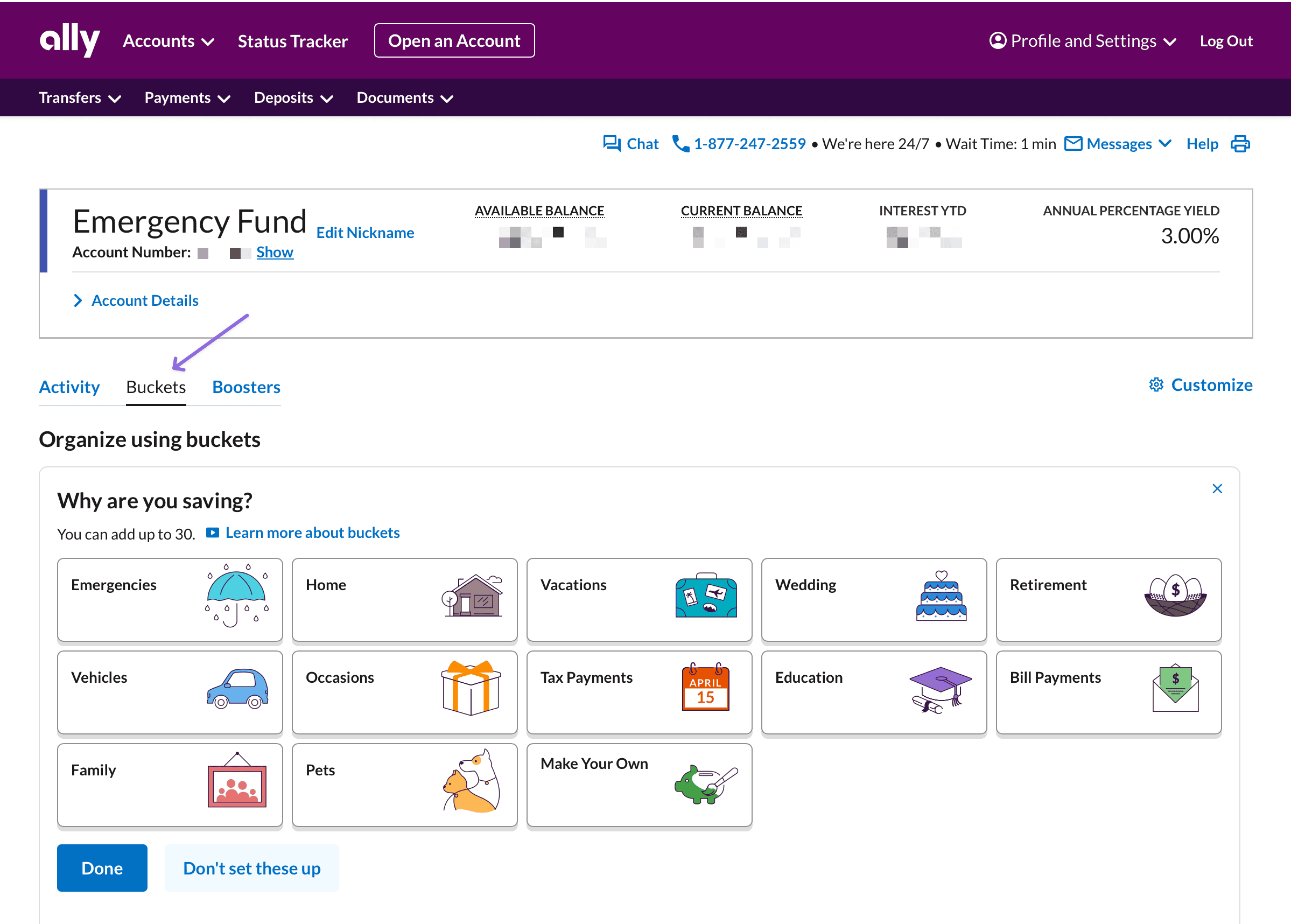
Your bank may have this feature (like Ally, which has savings buckets and spending buckets).
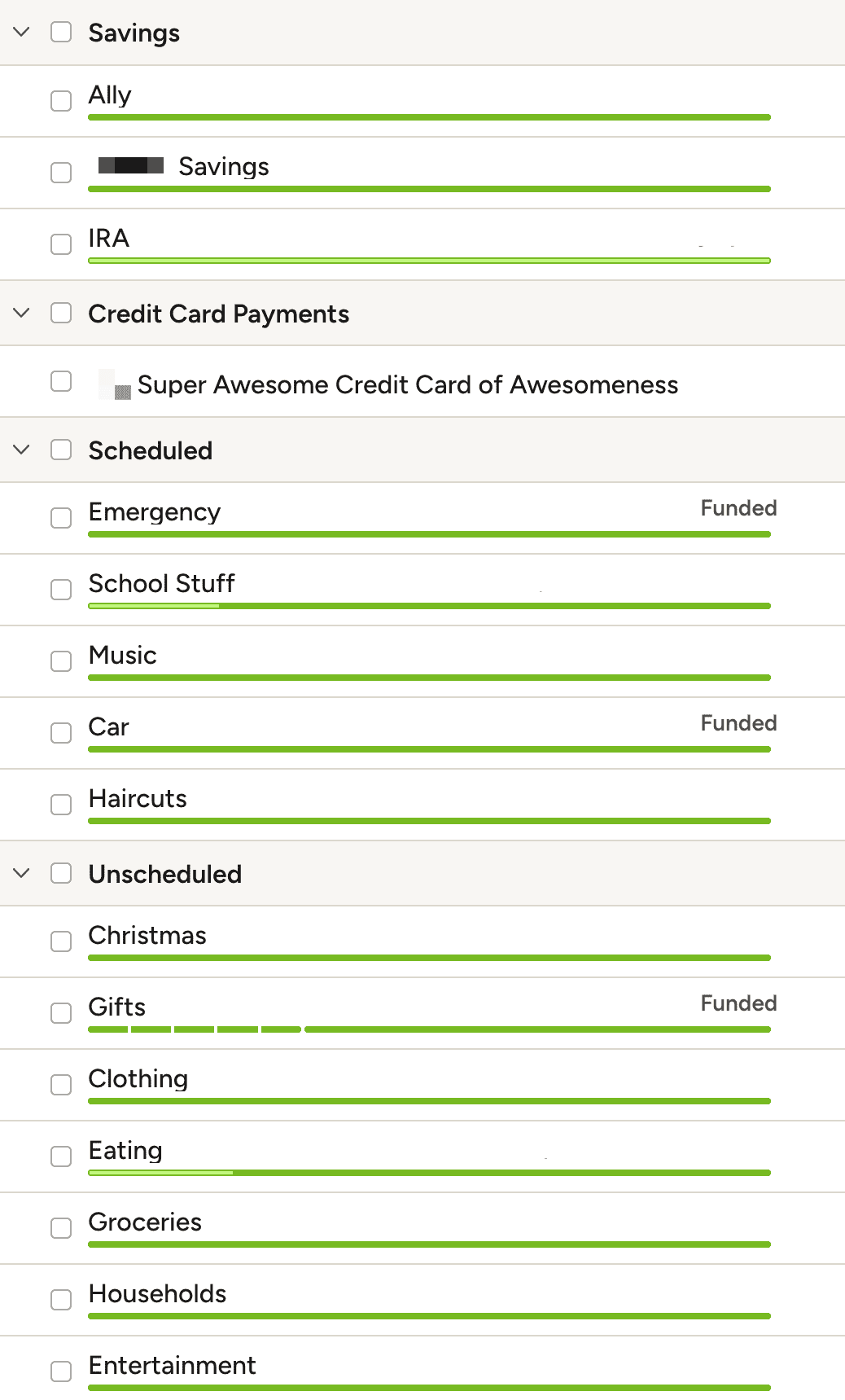
Or, try YNAB. Before J left for college, we did a fresh start on his budget which archives the history but keeps the bank connections. He thought about what categories he’d need for college, created those in YNAB and funded each category.
Also, if you’re headed to college, you can get a free year of YNAB.
Decide if it’s worth it
Now that you’re earning income regularly, tie your earnings to your spending.
One of the first money books I read was Your Money or Your Life which taught me to think about how you trade your money for things, and then ask yourself — is it worth it?
In my example above, the hourly rate is $16.50. If you go to the store and buy a pair of $50 shoes, is that worth 3 hours of work?
There’s no right or wrong answer. The important part is just that you think about it and decide for yourself!
Start a Roth IRA
A Roth IRA is a type of retirement account where money is taxed now, but not taxed when you withdraw it later.
You may think that it’s too early to save for retirement, but there’s no better time. More time until retirement = more time for growth!
Anyone with earned income can start and contribute to a Roth IRA.
There are limits to how much you can contribute to a Roth IRA — in 2026, the limit is $7,500 OR up to whatever you’ve earned for the year. This is why it’s important to have that last pay stub, so you can see the max of what you’re able to contribute, under year-to-date earnings.
There are income limits for contributing, too, meaning that if you make too much money, you’re not eligible to contribute, but that probably won’t apply since we’re talking about first jobs here!
J opened a Roth IRA at Vanguard, then:
- Connected his bank account
- Transferred money to Vanguard
- Picked specific funds to contribute to
- Here’s a great article about target date funds if you don’t want to pick specific funds
- For now, J chose to put money in VTI and VSGX (US and international stocks)
- Once he has a steady job, I’ll advise him to turn on automatic investment where he contributes a specific amount each month
And lastly, enjoy your newfound freedom! Your first job can be really eye-opening and a huge help to determine what direction you want to go in the future. It’s also great practice to develop good money habits!